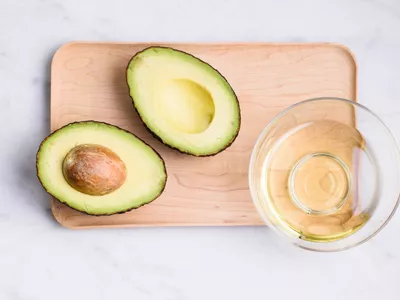
While many people enjoy using avocado oil in cooking, it is not as popular as other plant-based oils. But avocado oil is a healthy oil that has many uses in the kitchen. Some people even use avocado oil for hair and for skin health. Adding the product to your daily routine provides several key health and beauty benefits, especially when you use it in the kitchen to replace less healthy fats.
Nutrition Facts
The following nutrition information is provided by the USDA for one tablespoon of avocado oil.
- Calories: 124
- Fat: 14g
- Sodium: 1mg
- Carbohydrates: 0g
- Fiber: 0g
- Sugars: 0g
- Protein: 0g
Fats in Avocado Oil
There are three different types of fat in avocado oil.
There is a small amount of saturated fat in this oil. Saturated fats, like butter and animal protein, are often considered to be less healthy, as excess intake can increase LDL (bad) cholesterol which can increase the risk of heart disease. The American Heart Association recommends choosing oils with less than four grams of saturated fat per tablespoon. Avocado oil provides just under two grams of saturated fat per tablespoon.
You'll also get two grams of polyunsaturated fat when you consume a tablespoon of avocado oil. Polyunsaturated fats, also called PUFAs, can have a positive effect on your heart by decreasing bad cholesterol (LDL), so they are considered healthy fats.
Most of the fat in avocado oil is monounsaturated fat. Monounsaturated fats come primarily from plant sources and are usually liquid at room temperature.
Monounsaturated fats, also called MUFAs, are believed to increase your HDL cholesterol or "good" cholesterol. Health experts recommend that you replace less healthy fats (such as saturated fats and trans fats) with monounsaturated or polyunsaturated fat. The Academy of Nutrition and Dietetics recommends that 15 to 20 percent of your caloric intake come from monounsaturated fatty acids.
Carbs in Avocado Oil
There are no carbohydrates in avocado oil. The estimated glycemic load of avocado oil is zero.
Protein in Avocado Oil
There is no protein in avocado oil.
Micronutrients in Avocado Oil
While you get a healthy dose of Vitamin C when you consume a whole avocado, you won't get any Vitamin C or any other significant vitamins or minerals when you consume the oil, according to USDA data.
Also, many healthy eaters add avocado to their diets because of its significant fiber content. But you won't get any fiber from consuming the oil.
Health Benefits
Because avocado oil is high in oleic acid, you gain heart-healthy benefits when you consume it. Oleic acid is believed to lower LDL cholesterol (also known as "bad" cholesterol) to help decrease your risk for heart disease.
There is even some evidence that avocado oil may help with weight control, although the research has not been conducted on humans. A study performed on rats found that increased consumption of avocado oil improved glucose tolerance, insulin resistance, and contributed to lower body weight. And another study found improvements in metabolic markers in rats that consume avocado oil.
However, if you choose to include avocado oil in a weight loss diet it's important to remember that avocado oil, like all oil, is still fat. Fats contribute nine calories per gram as opposed to four calories per gram for carbohydrates and protein. So even though avocado oil is considered a healthy fat, you should still consume the oil and the fruit in moderation in order to reach and maintain a healthy weight.
Common Questions
What is avocado oil good for? What are some popular uses?
These are some of the most common uses of avocado oil outside of the kitchen.
- Avocado oil for skin. Avocado oil is less likely to clog pores than many other creams and oils. For this reason, some people like to use it to minimize the appearance of wrinkles and to soften the skin. As a moisturizing agent, avocado oil is also used in at least one of these best sunscreens. Some commercial avocado oils advertise that the vitamin E in avocado oil helps to boost skin health. However, according to USDA data, there is no vitamin E in avocado oil.
- Avocado oil for hair. Some men and women use avocado oil on hair to tame frizz and create a smoother appearance. Some people also believe that when applied to the scalp, avocado oil can stimulate hair growth. However, research is lacking to support this benefit. But since the product is odor-free and since it is not likely to clog skin pores on your scalp, adding some avocado oil to your hair routine (either by applying to the ends or in the scalp) may make your hair look healthier.
What is the best way to store avocado oil?
Most oils, especially those high in oleic acid, should be stored in a cool dry place, out of direct sunlight.
Cooking and Preparation Tips
Avocado oil has a higher flash point than other types of healthy oil such as canola oil or olive oil or even safflower oil. The flash point, or smoking point, is the temperature at which an oil begins to smoke fumes. The smoking point of avocado oil is over 500°F. For that reason, avocado oil is easy to use for high-temperature cooking
Avocado oil also has a neutral taste, although many describe it as buttery or nutty. But you won't get as much flavor from the oil as you do from consuming the fruit. However, avocado oil is easy to use in salad dressing and recipes. You can also use the oil in marinades, dips, and sauces, and also to grill, sauté, or stir-fry foods. You can even use it to coat pans to keep foods from sticking or to season cast-iron cookware. And, as you might have guessed, avocado oil is a key ingredient of many of these best dietician-recommended salad dressings.
Allergies and Interactions
Avocado allergies are possible in infants, children, and adults. If you have an avocado allergy, you may want to be cautious when consuming avocado oil. This oil is produced from the meat of the fruit (not the seeds or the skin) but allergies to avocado meat are not uncommon.
Allergy and immunology medical experts have established that avocado has a broad cross-reactivity with many other foods. Allergic reactions can simply occur by air-borne allergens (dust, pet hair, pollen) with related molecular structures to food-derived allergens cross-reacting. So if you have an allergy to other foods such as bananas or kiwis, you may want to undergo testing to determine if you have a reaction to avocado or avocado oil. The research has demonstrated that a reaction to the inhalant allergen natural latex may provoke a cross-reaction with food-allergen similar avocado, banana, kiwi, tomato, chestnuts, peach, mango, papaya, acerola cherry, and celery.
In addition, the American College of Allergy, Asthma, and Immunology explains that a condition called "oral allergy syndrome" may occur in people who are allergic to avocado. They say that itching in the mouth may occur after ingesting the food but symptoms such as hives, breathing difficulty, or anaphylaxis are rare because enzymes in your digestive system break down the allergen before your body can absorb them.
If you suspect you have an allergy to avocado or avocado oil, see your healthcare provider, as many tests are available to diagnose this.